
You can't deposit open rates. You can deposit sales from your email list.
Your email list is about to be your favorite thing you own. Every month you get a campaign strategy with email templates that are waiting on nothing but your voice and stories. Each one builds on the last, until buying from you is just what your list does
Write it yourself, use the AI prompts that come with it, or hand it to your team.
From $79/month. The first 50 members keep that price for as long as they stay.
You already believe in email. That's what makes this annoying.
You're not here to be convinced. You know it works. It's been a priority for a while.
The trouble starts when you do send something, because you can't tell what went wrong. Nobody opened it. Or they opened it and nobody clicked. Or they clicked and nobody bought. From where you're sitting those all look the same: an email went out, not much happened, and there's no way to know whether the subject line was weak, the offer was wrong, the timing was off, or the people you sent it to stopped paying attention eleven months ago.
So you do the thing that feels productive. Buy a template pack. Read about subject lines. Go grow the list bigger, on the theory that more people eventually means more sales. All of that is craft work, aimed at a problem that might not be craft.
The actual math is simpler than that. People who aren't opening can't click. People who aren't clicking won't buy. People who bought once won't buy again if nothing brings them back. Three different problems, three different campaigns, and trying to fix all of them with one Tuesday newsletter is how most people fix none of them.
“I have a good list. I email consistently. Now it's time to turn it into sales.”
Somebody posted that on Threads. Seventy-three people replied and not one of them had a real answer.
Most of them aren't selling anything. Drop 01 goes and gets the people who stopped opening, because a list that isn't reading you can't buy from you later. Another finds out what your people actually want. Another reconnects with someone who bought once and drifted off. One of them sells your holiday offer.
That's the whole idea. Newsletters so they know you. Campaigns so the relationship goes somewhere. Replies and clicks coming back the other way so you're not guessing what to send next. Revenue is what happens when you lead with strategy. It isn't what comes from the habit of sending one email a week.
Here's the answer. Newsletters are step one, and they matter more than anyone gives them credit for. They're how people get to know you, how you stay familiar, how you're not a stranger on the day you finally ask for something. Nothing works without that part.
Campaigns are step two. Not instead of step one, on top of it. A campaign is a set of emails with a start, a finish, and one job, sent to a specific group of people for a specific reason.
Here's how it works.
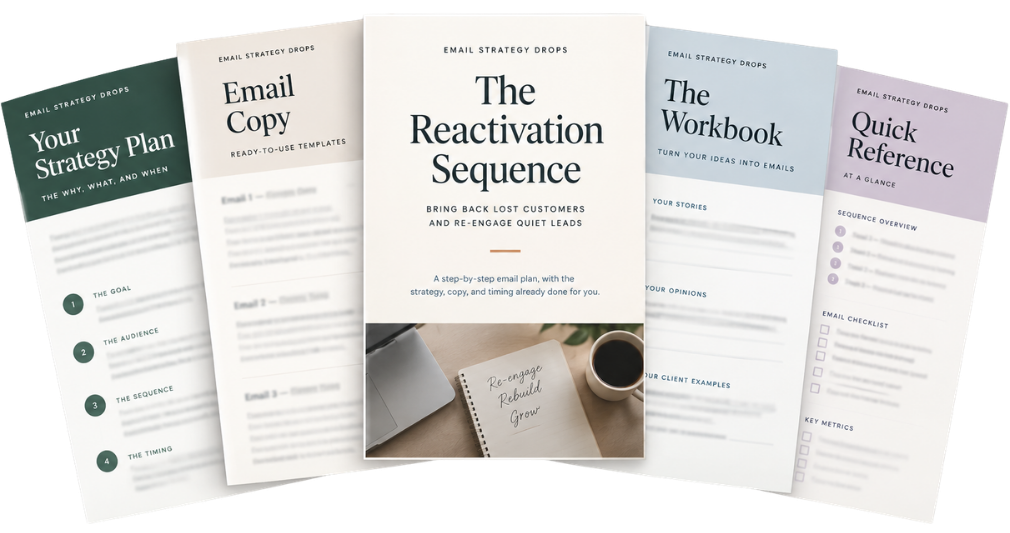
One drop a month, and every drop has one job. Waking up the people who've gone quiet. Finding out what your people actually want. Bringing back a buyer who drifted. Selling the thing you're launching. Sometimes that's one sequence, sometimes a few shorter ones, whatever the job needs. You run one at a time, which is the only way you'll ever be able to tell whether it worked.
The deciding is already done. That's the part that eats your month. What to send, in what order, to which people, and why. You're not getting a blank template and a pep talk. You're getting the plan, with the reasoning attached, so you know why email three sits where it does and why that one asks for a reply and this one doesn't.
And it sounds like you. Every drop starts with a workbook that pulls your own stories, opinions, and client examples out of your head before you write a word. That's the document that decides whether your emails sound like you or like something bought off the internet, and it's the starting point whether you write them, hand them to your team, or draft them with AI.
Every drop is five documents.
01
Start Here Guide.
What this drop's job is, what you're building, and the decisions to make before you begin. Five minutes. Read it once and you're done with it.
02
The Story Mining Workbook.
Where your raw material comes from. Your stories, your opinions, your client examples. It's the document that decides whether your emails sound like you, so it earns the time.
03
The Templates.
A template for every email in the drop, the strategy behind each one and why it sits where it does, and five subject line angles to pull from.
04
The Setup Guide.
How to build it in your email platform, who it goes to, and how to measure it. The technical details that are easy to miss until something's already gone out wrong.
05
The AI Prompt Pack.
Prompts that walk an AI tool through drafting each email using your workbook answers. One route through the drop, not the route. Some people want it, some need it to get anything written at all, and some would rather write every word themselves.
Everything lands by email. No new platform, no separate login, nothing else to keep track of.
One drop, four ways through it.
However you get words onto a page, this is built for it.
01
You write it yourself.
The workbook gives you the raw material, the Sequence gives you the structure and the reasoning. You do the writing, which is how you'd want it if writing is the part you like.
02
You use AI.
The Prompt Pack walks an AI tool through drafting each email using your workbook answers, so it's working from your material instead of from nothing.
03
Your team writes it.
This delegates well. You do the Story Mining Workbook yourself, because those answers can't come from anyone else, then hand your writer the workbook, the Sequence, and the prompts, and review what comes back.
04
Or somewhere in the middle,
which is where most people land. AI for the two emails you're dreading, your own hands on the ones that come easily. Nobody's checking.
Whichever route you take, it starts in the same place. The Story Mining Workbook is the input for all four. Your stories, your clients, your opinions, pulled out of your head before anything gets written. That's why it earns the most of your time, and it's why four different routes all end up sounding like you.
About the AI prompts, because "includes AI prompts" has stopped meaning anything.
Most of them amount to “write me a re-engagement email,” which is exactly how you end up with the same email everyone else in your niche sent last Tuesday.
These run on your workbook answers. Your stories, your clients, your opinions, in your words. The AI isn't inventing a voice for you, it's arranging material you already handed it.
That's the difference between using AI and sounding like you used AI.
Your favorite small brand doesn't restock the same five shirts forever. They put out a capsule. It has a concept, it does its thing, and then the next one lands.
Same idea. Same brand every month, new job every month. Drop 01 has one goal and every email in it points at that goal. Sometimes that's one sequence, sometimes it's a few short ones, whatever the job actually needs.
What it saves you: nobody hands you a library of 200 templates sorted by industry, which is sorted by nothing. One drop, one job, one thing to run at a time.
Why “drop”?
DROP 01 / In Full
The Re-Engagement Campaign
The problem it solves: somewhere on your list is a group of people who signed up, meant it at the time, and have since gone quiet. Not all of your list, and rarely most of it.
What you build: a six-email sequence, sent to that group and nobody else. Your normal sending carries on exactly as it is.
01
Strategy: Give something useful, ask for nothing
The Ask: A reply invitation, low-key
EMAL
Give something useful, ask for nothing
STRATEGY
A reply invitation, low-key
02
Strategy: Give again, so the first one wasn't a fluke
The Ask: A reply, asked for properly
03
THE ASK
Strategy: The lightest email in the campaign
The Ask: A poll, which splits what comes next
04
Strategy: Deliver exactly what they asked for
The Ask: Nothing. The email is the delivery
05
Strategy: Reconnect as a person, not a source of tips
Give again, so the first one wasn't a fluke
The Ask: A reply, following from the story
06
Strategy: Bridge back to your normal sending
The Ask: What's coming next, plus a reply invitation
Email four has up to four versions, one for each poll answer plus a general one for anyone who didn't vote. Whichever version somebody gets, they never know a split happened. It reads as one email, written for them.
At the end you get one number: how many people on your list you now have a real chance of selling to, who you had no chance with a month ago. The Setup Guide shows you exactly how to get it.
A reply, asked for properly
This is the same strategy I used to bring back 558 subscribers who hadn't opened an email in over a year.
You may have seen this called a win-back sequence, a re-permission campaign, or an inactive subscriber sequence.
The lightest email in the campaign
A poll, which splits what comes next
Deliver exactly what they asked for
Nothing. The email is the delivery
Reconnect as a person, not a source of tips
A reply, following from the story
Bridge back to your normal sending
What's coming next, plus a reply invitation
That's one drop. There's another one on the 1st of every month.
From $79/month. The first 50 members keep that price for as long as they stay.
Every drop includes templates, because staring at a blank screen is where most email plans quietly die.
But a template only becomes an email that works once three other things are attached to it: a reason it exists, a way to make it sound like you, and somewhere to go when you get stuck. Most template packs sell you the file and wish you luck.
You get the templates here too. You also get the three things that make them work.
| A template pack | A course | Done-for-you | Email Revival | |
|---|---|---|---|---|
| Templates | Yes, lots | Sometimes | — | Yes |
| Why each email exists | — | In general terms | Not your concern | Explained, campaign by campaign |
| A process to make it yours | — | — | — | The Story Mining Workbook |
| Works whether you write it, your team writes it, or AI drafts it | You're on your own | — | Not applicable | Four routes, same drop |
| Someone to ask | — | Maybe a forum | Account manager | Office Hours, every month |
| Feedback on your draft | — | — | They wrote it | Copy Critique, Tier 2+ |
| A read on your numbers | — | — | Their report | KPI Review, Tier 3 |
| Cost | $27 – $97 once | $500 – $1,000 | $1,200+/mo | From $79/mo |
A few things I'd rather say now than later.
Email takes time, and it's lucrative. A campaign takes a few weeks to play out before the numbers mean anything, and the real gains come from stacking campaigns over months. The payoff is real. It just isn't fast, so if you need this fixed by Friday, this isn't the thing.
Some drops won't be for you that month. If one lands and it isn't where your list is right now, put it aside. They're evergreen, nothing expires, and plenty of people prep one early and sit on it until the moment arrives.
The emails get written on your side. I hand you the strategy, the templates, the workbook, the prompts, and the setup, and I'll critique your drafts and read your numbers. What I don't do inside the membership is write them for you. Whether that's you, your team, or an AI tool with your workbook answers in it is entirely your business. If you'd rather hand the whole thing off, I do offer full email management, and that's a separate conversation. Just don't buy the membership expecting it.
Is this for you?
This is for you if:
01
You have a list. Any size. You just aren't doing much with it.
02
You suspect it's underperforming and you can't tell why.
03
You send consistently, or you'd like to, and you're ready for the part that actually sells.
04
You can give it a couple of hours a month, and you'd rather that time went into something with a plan behind it.
05
You have an email platform and you can find your way around it, or you're willing to learn.
06
You write your own emails, or you use AI, or somebody on your team writes them. All three work here, and so does any combination.
This isn't for you if:
01
You don't have a list yet. This isn't a list-building product, and starting here would be out of order.
02
You want somebody else to own the writing start to finish. That's my email management service, not this. Same brain, different arrangement, ask me about it. Handing it to your own team is different, and it's well supported here.
03
You want the biggest possible pile of templates for the smallest possible price. Those exist and they're cheaper. Go get one, I'd rather that than you paying me for something you won't use.
04
You need results this month. That's a longer conversation than a sales page can have. Book a call and we'll work out whether it's even possible, and whether email management or a one-off copywriting project gets you closer than a membership would.
Still not sure? Email me at bailey@funnelrevival.com and ask. I'll tell you honestly if it's not the right fit.
Pick your tier.
Everyone gets the drop and Office Hours, whatever tier they're on. Drops land on the 1st. Office Hours is the last Wednesday of the month, 1:00 PM Central.
Tier 1
$79 /month
The way in.
Drop 01 the day you join, then a new drop on the 1st of every month. All five documents, every time.
Office Hours, live, once a month
The archive, where every drop lives together, building as you stay
Most people should be here
Tier 3
$297 /month
Everything above, plus somebody actually reading your numbers.
Everything in Tier 1 and Tier 2
Quarterly KPI Review. Three months of data, regular sends and campaigns together, in a short video walkthrough with two or three specific things to do next.
Most business owners can't tell whether their email is working, because nothing is being measured properly. This is the tier that fixes that. If tracking is the part you know you'll avoid, look here first.
Tier 2
$197 /month
For when you can write it but can't tell if it's right.
Everything in Tier 1
Copy Critique. One full sequence from any drop, or up to three other emails a month.
A recorded video breakdown covering two things: whether the email is strategically doing its job, and whether the writing is doing that job justice.
Not a rewrite, and not general encouragement. The line-level notes that decide whether an email gets ignored or gets a reply.
Founder pricing, and what happens to it. The price goes up as this proves itself, not on a countdown timer. Whatever the first 50 members join at is what they keep paying, for as long as they stay subscribed. No fake deadline, no member cap on the membership itself. Fifty is just where the price changes.
Standalone KPI Audit — $550. A one-time review with no membership attached. Worth knowing: Tier 3 is $297 a month, includes a version of this every quarter, and comes with everything else. I'd take the membership.
What this kind of work does
These are results from my own client work, built with the same strategies that go into these drops. When members start reporting their own numbers, those go here and these move down the page, because a member's result is worth more than mine.
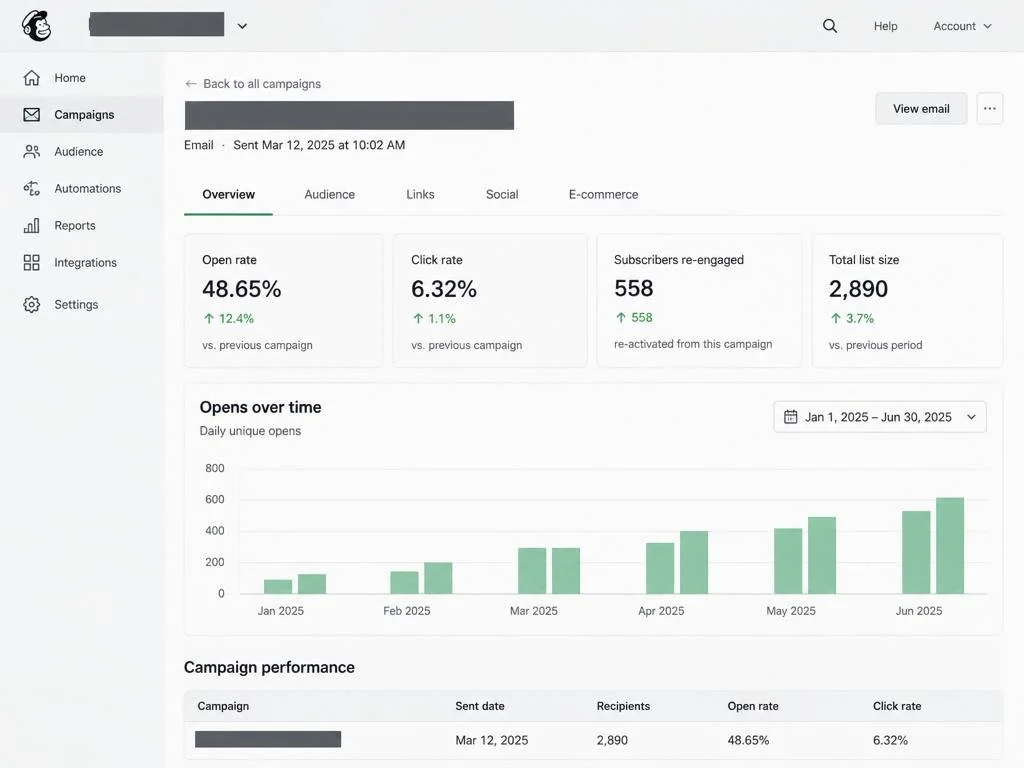
558
SUBSCRIBERS REVIVED
A service provider with a badly dormant list. 1,692 of 2,890 subscribers hadn't opened anything in over a year. Five months of winback work brought back about 558 of them. That's 558 people they can sell to now, who they had no chance with before. This is exactly the job Drop 01 does.
48.65%
OPEN RATE
A personal brand running two businesses off one list. A seven-email behavioral routing sequence opened at 48.65%, against a 20–30% average for coaching and education brands. Both of her lists grew at the same time instead of one eating the other.
100+
APPLICATIONS
The NASDAQ Entrepreneurial Center. A six-week campaign to recruit applications for a pitch competition. Target was 60. It brought in 100+ applications, 67% over goal, and three of the eleven U.S. finalists came through it.
I'm Bailey.

For some clients I'm the fractional CMO, which means I'm the one in the room when we decide what we're selling, to whom, and why anyone should care. For others it's one funnel or one campaign. I started out as a copywriter, so I still write the words, and I've spent enough years staring at analytics to tell you when the words didn't work.
That's why the email strategy holds up. An email campaign doesn't live in a vacuum. It sits downstream of your offer, your positioning, and every other thing you have running, and most email advice pretends otherwise. I can't pretend, because on half my accounts I'm the person who has to answer for all of it.
The work has been a pitch competition for the NASDAQ Entrepreneurial Center, a segmentation system for a woman running two businesses off one list who was watching them cannibalize each other, and a truly unglamorous amount of time bringing dead lists back from the dead. Nobody puts that last one on a sales page. It's most of the job.
Email Revival exists because I kept meeting the same person. Real list, real audience, real offer, completely stuck. Not because she couldn't write. Because nobody ever told her what order to do things in, or how to know if any of it worked.
That's a strategy gap, and strategy gaps are fixable. So I'm handing mine over, one campaign at a time, and showing my work as I go.
Before you join.
-
You can, and you should know I'd rather you bought one of those than paid me for something you won't use. But the template was never the hard part. Filling one in so it sounds like you, sending it to the right group of people, and knowing afterward whether it worked, that's where things stall, and that's what the other four documents are for.
-
Depends what small means. A hundred people who came to you on purpose is a real asset, and there's more you can do with it than you'd think. Keep growing it, though. Growth matters and nothing here replaces it. The drops run alongside your list-building rather than instead of it, and since every drop has a different job, there's usually one that fits whatever stage you're at.
-
Then don't write them. Use the Prompt Pack, or hand it to whoever writes for you. The only part that has to be yours is the Story Mining Workbook, because those answers can't come from anyone else. Everything downstream of it can. And you're on your own timeline here. Run a drop the week it lands or three months later. Nothing expires, nothing unlocks in a set order, and nobody is waiting on you.
-
Good. That instinct is why your list is still worth something. Every drop is built to be sent to a specific group for a specific reason, which is the opposite of blasting everyone and hoping. And Drop 01 in particular gives twice before it asks for anything.
-
Sometimes, yes, and I'd love to talk about it. I offer full email management separately, where my team and I own the whole thing start to finish. It isn't what the membership is, and it isn't $79. Book a call and we'll work out whether that's actually what you need. If the membership would serve you better, I'll say so and save us both the call.
-
Every Setup Guide is written to work across platforms, with the terminology differences called out, because Kit, Flodesk, Mailchimp, MailerLite, and ActiveCampaign all draw those lines slightly differently and frequently contradict each other. If yours is unusual, bring it to Office Hours, and we'll work it out.
-
Probably not as late as you think. Everyone on that list raised their hand once and meant it. They've mostly forgotten you rather than rejected you, and those need very different tactics. Rejection needs persuading. Absence just needs a reason to look.
-
I know. That's why a drop is one campaign with one job rather than a library you have to navigate, and why there's a live call every month to get you unstuck.
-
No. Run whichever one matches the problem your list has right now. They're evergreen and none of them expire.
-
Yes, any time, up or down.
-
Every drop tells you to make your own copy of each document, and those copies are yours for good. I can't take them back and wouldn't want to. What ends is access to the archive.
-
The 1st of every month.
-
One live call a month, last Wednesday of the month at 1 pm CST, open to every tier. Members send questions ahead of time, and I work through them, then take live follow-ups if there's room. Bring anything that isn't working or any decision you'd rather not make on your own. For that hour, my brain is your brain. Every call is recorded and kept in the library, so you can watch it back or go through old ones. And you'll have my email address for the other twenty-nine days of the month. People use it. I answer.
-
Send your question ahead of time, and you'll get it answered whether or not you're in the room. The recording goes in the library either way, so nothing is lost by missing one.
Ready when you are
You can't deposit open rates. Let's go get you some sales
If you're not sure which tier: Tier 3 if tracking is the thing you know you'll avoid, which is most people, and it's the one that tells you whether any of this is working.
Tier 1 if you'd rather test the water first, which is completely reasonable and exactly what that tier is for.
Billed monthly, cancel whenever. Drops land on the 1st. The first 50 members keep this price for as long as they stay subscribed.
Still deciding? Reply to any of my emails and ask me. I'll tell you honestly whether it's the right fit, including when it isn't.